
Eye Contact Is Everything
12 things I found in July.


Every last Wednesday of the month, I’ve been sharing a dozen of the best things I found out there. Writing. Music. Podcasts. Films. Gear. Recipes. The intent is to maintain a punchy counter against the algorithms and to amplify the beautiful work of others. Here’s a link to previous lists so far.
HERON PISS. Mike Foote is a professional North Face athlete from Missoula, Montana, a race director of The Rut Mountain Runs – one of the largest mountain foot race weekends in the country – a close friend, and one of the best humans I know. He’s also a terrific writer. We’re in a super-secret “bad fiction writing cult,” too (just outed us). In my competitive ultrarunning days I looked up to Foote as one of the best in the business, and always knew him to be an incredibly deep feeler, thinker, and community visionary, but his new essay recently published on the Dirtbag Diaries (18 minutes) made me weep. When people hear me say that running needs better writers, this is the kind of story I’m looking for. Humble, woven, personal, funny. My mother’s celebration of life is this weekend, and Mike’s decision to really go there about his dad’s life and death, his own struggles with mental health as an endurance athlete and father, and, yes, drinking great blue heron piss. So good. (Mike and I are now fellow Dirtbag Diaries alumni; twelve years ago I recorded a short about a protest I organized in Mexico to stop a gold mine.)
ZOMBIES. This tip comes from dear friend and artist Brendan Leonard. I was in my local credit union bank the other day and was surprised to hear Halloween by The Misfits playing on the radio. It reminded me of a previous younger self covering Misfits, Exploited, Circle Jerks, and Crass as drummer for a (very bad) punk band in high school. After telling Brendan this on a very long, very ridiculous run together a few months ago (short film forthcoming, stay tuned) he sent me a playlist of acoustic covers of Astro Zombies by The Misfits. Nothing is better on the Internet than this, promise.
DORITOS. Speaking of Brendan Leonard, he recently invited me to be a guest on his wonderfully hilarious podcast, Five Favorite Things. He has guests on to discuss “five books, movies, music, art, and other creative works that have helped shape their lives.” It’s only half-serious. Items for me included David Abram’s Spell of the Sensuous, Japanese-style woodcut prints by Tom Killion, and, of course, Salsa Verde Doritos. (It’s a story that includes climbing Mount Hood with Robert Macfarlane a few months ago and eating these chips together afterward and saying something really dumb out loud in the presence of one of the best living writers. Take a listen.)
GRIEF. Prentis Hemphill is a writer, teacher, and embodiment therapist, and their podcast, Becoming the People, is in steady rotation these days. They are clear-eyed grounded conversations about the real shit, and I found their recent conversation with Francis Weller – grief therapist, writer, facilitator – particularly poignant, as they’d both just lost family members within weeks of the recording. I’ve read all of Weller’s work and listened to a fair amount of interviews with him, but this might be his best. I was late to the game on The Wild Edge of Sorrow, but it’s a non-negotiable must-read for….everyone.
KLEIN. Subtack nearly broke the day Naomi Klein entered the chat. One of the best thinkers alive in the complicated times we’re in is now running a Substack and I implore you to follow along. I first read Klein thanks to my college roommate and visionary Nate Bacon, who had No Logo on our shelf. I’m now a Klein completist and have recommended her on multiple twelve things roundups. Her forthcoming book, End Times Fascism and the Fight for the Living World, co-written with Astra Taylor, out 9/15, will make a huge splash I promise. If you’re new to her work, I’d recommend starting with The Shock Doctrine, then This Changes Everything, and then her latest, Doppleganger.
ICELAND. My fiancé, Erin Hilgendorf, brought to attention this exquisite Icelandic drama-comedy film, The Love That Remains (trailer). It follows an artist and her family as she navigates divorce, capitalism, loss, and motherhood. The film is raw, perfectly paced, funny, and simultaneously heart-breaking/heart-mending. The director, Hlynur Pálmason, was the mastermind behind Godland, which I really enjoyed, though it was the last film my mother and I ever watched together, and she wasn’t a huge fan. “Nicky, what was that? Stupid dark!”
BISON. Last night I had the following ingredients available: ground bison meat, sweet potatoes, chard and kale from the garden. This summer taco bison salad with potatoes recipe (this one, too) met every mark, and will be an easy bowl I’ll be throwing together for company more often. Protein-rich, dark leafy greens from, like, fifteen feet away, and local meat, if you’re into that kind of thing.
SUN HOODY. I’ve been training for a very large, very remote expedition next month that I can’t wait to share more about, mainly by walking up and down and around steep places and high country for hours this past month with a heavy backpack, and it’s been categorically hot every outing. Luckily, I have Patagonia’s Capilene Cool Sun Hoody that’s keeping me protected from hours under the sun. It’s a garment with an incredible amount of versatility, to be used in hot climates and also cooler alpine exposure. I toggle back and forth with Outdoor Research’s Echo sun hoody and love both equally.
O’KEEFE. Another Hilgendorf recommendation here, but this Georgia O’Keefe documentary, The Brightness of Light (trailer) really drops you into this complex and strong-willed artist and woman. When I lived in New Mexico, I visited Ghost Ranch and knew a bit about her life and work, but this documentary offered such texture to her life in New York City, her husband Alfred Stieglitz (who I didn’t know looks exactly like Carl Jung), and so much more. We’ve toggled this kind of film while working our way through Ken Burns’s PBS documentary on Thoreau, which is also highly recommended. (Oh, and, of course, the fifth and final season of The Bear. RIP.)
BROMANCE. So much has been written recently about the “Male Loneliness Epidemic,” and the “Anti-Social Century” which I find fascinating, but the recent article in The New Yorker, “The Lost Art of the Bromance,” (thanks for the tip, Trevien Stanger, with whom I have a deep bromance) digs deeper into the shallowness of attempts to heal this cultural wound, and, therefore, having it bleed all over the place. I love how the writer incorporates the reboot of Jackass as a way in. A takeaway for me: it’s the quality and depth of connection that’s key, that men being with men doesn’t just mean to train or to “life hack” our way to happiness or play video games together, but it’s a longer burn than that. It’s offline time with intimacy, not centered on doing and more on being that’s the true lever of transformation. (This echoes a bit of a wonderful conversation on the optimization paradox with Cal Newport.)
SEDARIS. I’ll admit: I haven’t actually read a ton of David Sedaris, but in his promotion for his new book, I’ve been transfixed by his brain, how he thinks, how he tells stories, his audacity and subversion and confidence. For writing nerds, this “How I Write: Lessons from Decades of Writing” episode gets into the weeds and is wonderful. The Wild Card episode is also hilarious. (I think it’s this interview where he goes off on how much he hates when people say “perfect,” in emails and in the world. Perfect!)
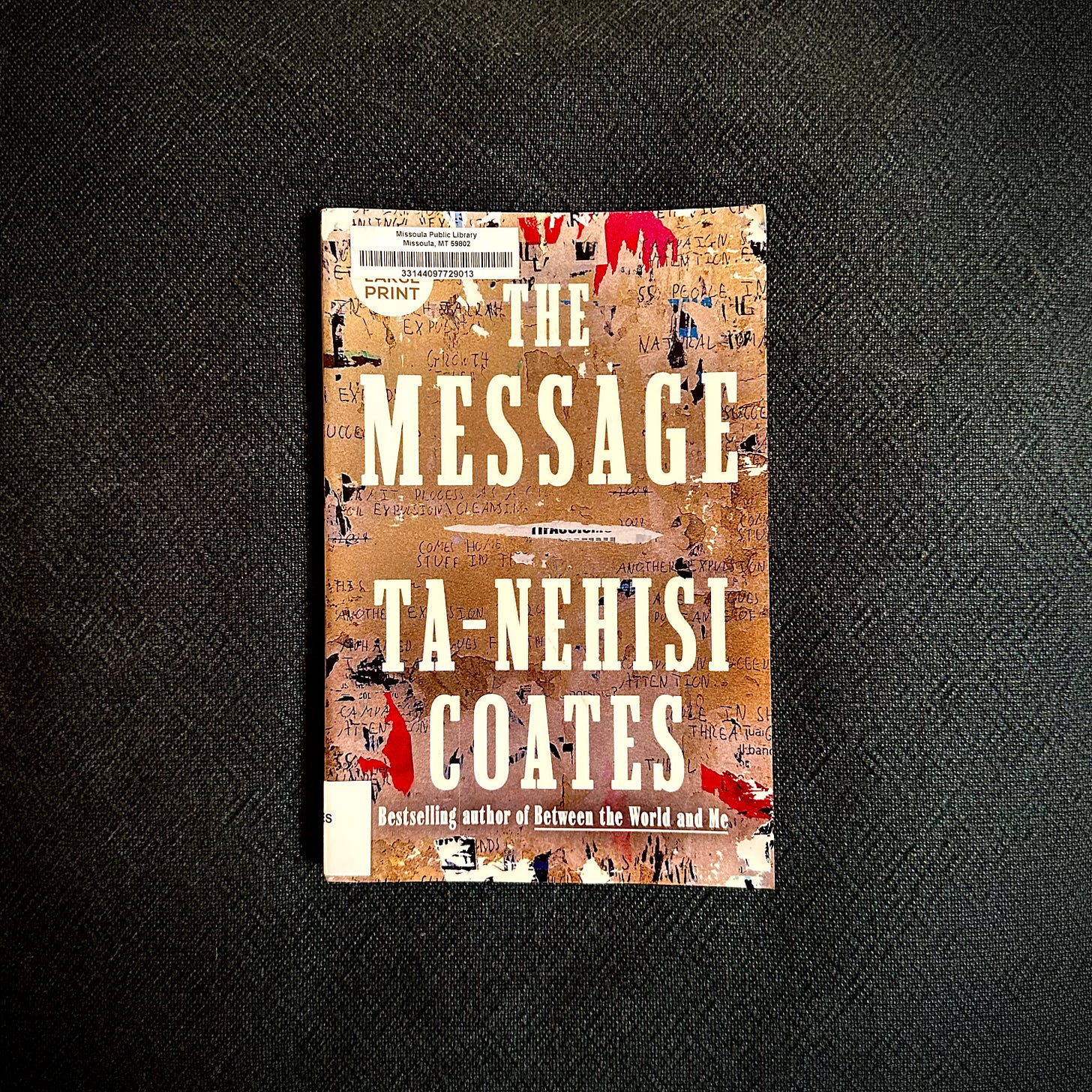
MESSAGE. Book 143 of 200 on the Mandorla 200 is The Message by Ta-Nehisi Coates (2024). I’ve been waiting patiently for this one in paperback and could only find it at the library in large print, which is its own interesting reading flow state. I’ll follow Coates’s brain anywhere it goes, especially when it steps into Palestine, into the ghosts of the Jim Crow south, and into Dakar. Here’s my 200-word microdistillation:
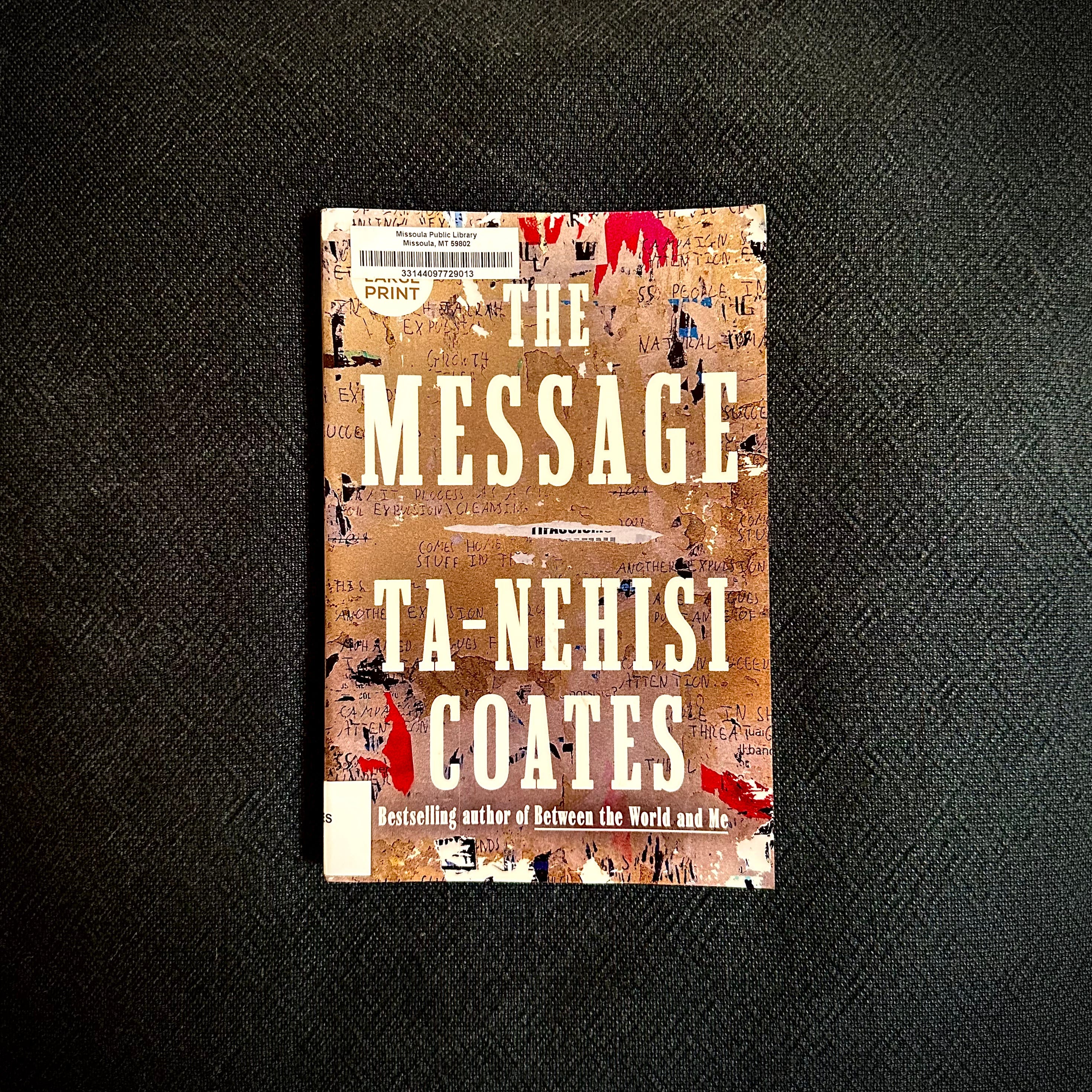
(143/200) Writing is a snake. The creature moves, slides, its words and rhetoric and scaled tube of a body moving and out of the light. Stories that ride on its back shape the way we see, the way plunder can become acceptable, or the way domination persists without interrogation. Writing can be a liberating force but it must also be recognized as its own weapon, and that the task of making political writing something like art is more complicated and urgent than it seems. Every empire needs a good yarn to justify its take, to imbue a deep belief into its subjects that its myths are one of civility, not of occupation or enslavement. The snake with the story on its back winds through time and through tall grasses. What are its aims? Where do our messages not confront their own ventriloquism? Where might our approaches to language and liberation start from a place of orientation and context, to see hegemonic word counts and editorial othering for what it is? The point: take every word spoken, or written, or read more seriously than ever. Respect its power as both wand and weapon, spells cast in every direction. Then write like wildfire.
I look forward to these recommendations at the end of each month.
Recently I went back to the town I used to live in to visit the bakery and the used bookstore. While scanning the shelves I came across your book The Way Around. Now, this may not seem unusual - a book in a bookstore - but this happened in a small town in Canada. Seeing the book on display filled me with excitement and I’m almost finished reading it. I’m now noticing circles everywhere - I hope you keep writing.
Eating a pastel de nata and drinking some v special Montana tea as I read.